Mon Aug 03
When the Test Tool Itself Needs a Certificate
AI is moving into avionics test benches, and DO-330 tool qualification rules were never built for nondeterministic outputs.
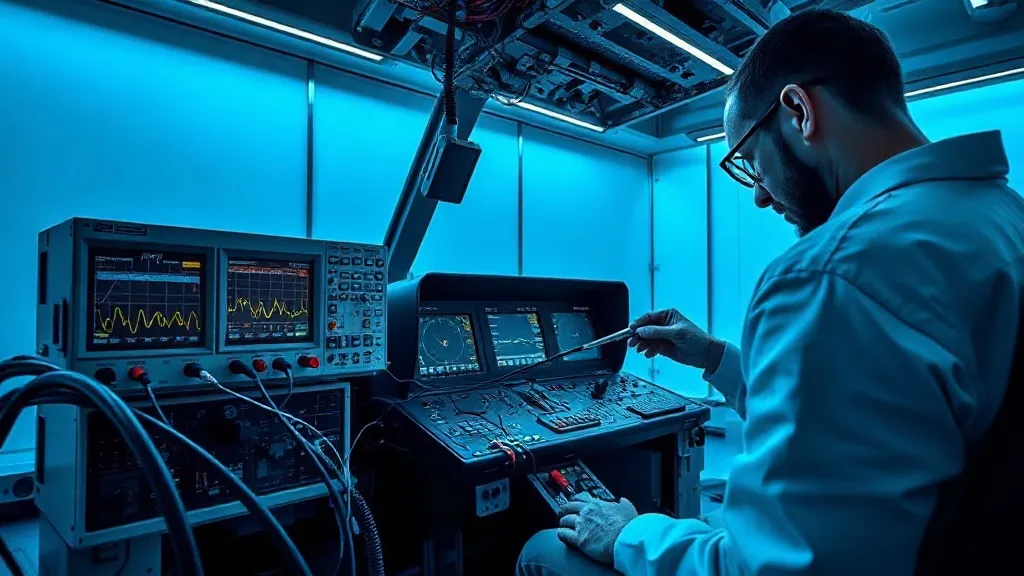
Emerson’s latest release folds Nigel AI into the broader NI LabVIEW+ suite, including InstrumentStudio, FlexLogger, and VeriStand, bringing “context-aware intelligence” into interactive measurements and hardware-in-the-loop testing for software test productivity. For avionics programs, VeriStand and FlexLogger are not peripheral tools. They sit inside HIL benches that verify flight control and engine software against DO-178C objectives before an aircraft type gets near EASA or FAA sign-off.
That placement matters more than the productivity headline suggests. DO-178C draws a hard line around tools that could fail to detect an error in the software under test. If a tool falls into that category, DO-330 requires it to be qualified at a tool qualification level tied to the design assurance level of the software it supports, up to TQL-1 for the most safety-critical code. The qualification regime assumes a tool behaves deterministically enough that its failure modes can be characterized and tested once, then trusted repeatedly.
An AI layer sitting inside VeriStand or FlexLogger, shaping how test signals get interpreted or which anomalies get flagged, does not fit that assumption cleanly. Buyers evaluating this expansion need to ask a specific, unglamorous question: does Nigel AI ever influence a pass or fail determination on DAL A or B software, or is it strictly a workflow accelerant that a human verifies independently before any certification credit is claimed. The answer changes whether the tool needs DO-330 qualification evidence at all, and if so, at what level.
The certification stack was not built for this
Ga-Telesis markets its distribution business on a dense stack of aerospace credentials, AFRA, ASA100, AS9110, AS9120, ISO 14001, ISO 45001, ISO 50001, alongside FAA, EASA, and CAAC recognition, as proof of trusted process control. That stack works because parts distribution is a deterministic, auditable chain: a part either meets spec and traceability requirements or it does not. Test tooling under DO-330 was designed on the same logic. A tool’s behavior gets fixed, documented, and re-verified only when it changes.
AI-driven test tools do not sit still the same way. Model updates, prompt changes, or retraining can shift outputs between releases in ways that a traditional tool version bump does not. That is a real gap between how DO-330 was written and how these tools now ship.
EASA has already flagged 2026 as a year for convening the industry on safety practice, with registration open for its Annual Safety Conference in November. Tool qualification for AI-assisted test environments belongs on that agenda, not as a side session but as the main one.
The decision in front of engineering leadership
Programs adopting Nigel AI, or any AI layer inside a certified test suite, need a documented boundary today: where AI output stops being advisory and starts touching verification evidence. Absent that boundary, the qualification burden defaults to the most conservative reading of DO-330, and audits will find it.
Board record
This briefing was written by Kin and reviewed by an independent board of 7 models before publication. Ruling: CLEARED.
| Seat | Reviewer | Finding |
|---|---|---|
| Chair · Editorial Judgment | Claude | cleared. Core argument linking AI non-determinism to DO-330 qualification gaps is coherent and valid, but the Ga-Telesis paragraph is a non-sequitur—parts distribution credentials illustrate ‘deterministic aud |
| Source & Claim Verification | Qwen · hosted fallback (qwen-2.5-72b-instruct) | cleared. Most claims are well-supported, but the assertion about the 2026 EASA conference and the specific focus on AI tool qualification is not clearly backed by the provided sources. |
| Regulatory & Framework Fidelity | Mistral | cleared. The briefing accurately reflects DO-330 and DO-178C requirements but does not explicitly address ISO 42001, EU AI Act, FDA, or MDR/IVDR compliance gaps or alignments. |
| Technical Accuracy | Llama | cleared. The article accurately captures the challenge of integrating AI-driven test tools with DO-330 qualification requirements, highlighting the need for a clear boundary between AI output and verification |
| Bias, Balance & Hype Control | Gemini | cleared. The briefing effectively identifies and scrutinizes potential vendor hype around ‘context-aware intelligence’ by framing it against the stringent, deterministic requirements of DO-178C and DO-330, hig |
| Novelty & Non-Duplication | Grok | held. The Emerson/Nigel product hook is commodity wire copy, but the specific DO-330 nondeterminism gap for AI inside VeriStand/FlexLogger HIL evidence chains is a sufficiently sharp, under-served angle not |
| Validation | DeepSeek | cleared. The central claim that AI-driven test tools create a novel qualification gap under DO-330 is strongly validated by the deterministic design of the standard and the non-deterministic nature of AI updat |
Sources cited: 7. Validation challenges: 0. Review cost: about $0.04. Learn how these briefings are written and verified.
Record corrected 29 September 2026. This seat was originally listed as running on our own local hardware. It never did: every review before this date fell back to a hosted model, and the row above now names the model that actually ran.