Sat Aug 29
The Energy Layer Missing From Industrial AI Safety Cases
AI-augmented HAZOP is testing industrial AI safety cases, but the harder unresolved question is power and grid resilience, not just compute.
HAZOP is the right test case, with a real limit
AI-augmented HAZOP has become the clearest proving ground for industrial AI, and for good reason. It applies AI to a knowledge-intensive safety workflow while keeping expert judgment in the loop, using semantic data models and governed AI assistance rather than autonomous decision-making (ARC Advisory Group). Automation World frames the stakes well: industrial AI recommendations touch worker safety, product quality, and equipment performance, so every output has to withstand scrutiny before anyone acts on it (Automation World).
That framing is sound, and it is also incomplete. A recent safety review makes the gap explicit: strong laboratory results do not transfer cleanly to noisy, physical operating conditions, and that is exactly where accountability gets hard to trace when something fails (24-7 Press Release). The instinct among vendors and standards bodies has been to treat this as a model validation problem. It is also an infrastructure problem, and a more specific one than most compute discussions acknowledge.
Compute readiness is the visible gap. Power is the harder one.
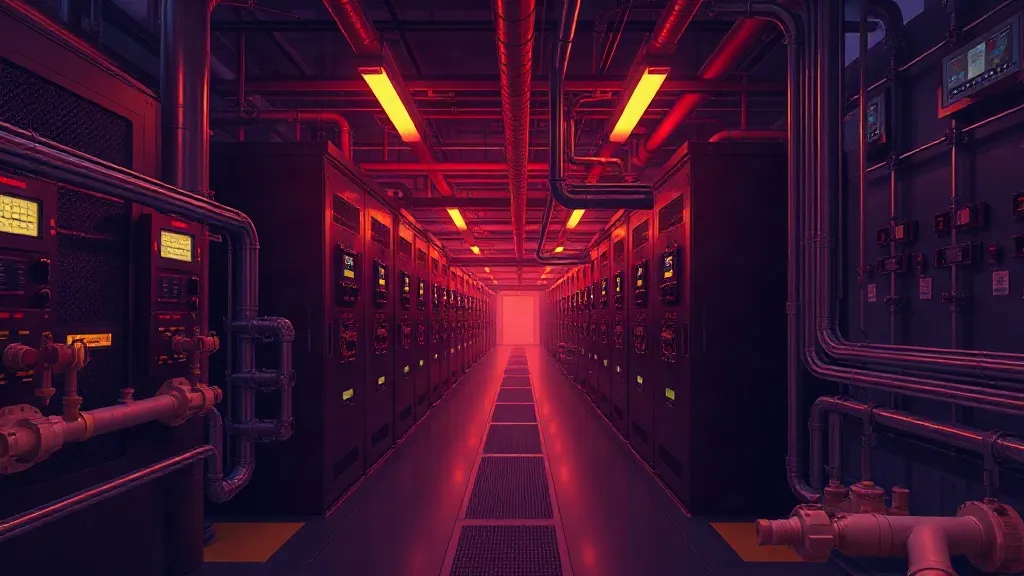
Emerj’s analysis of physical-economy AI describes an architectural deficit between operational demand and infrastructure readiness, with real-time, safety-relevant workloads running on compute maturity far behind what the digital economy already built (Emerj). That deficit is not only about chips. US power demand tied to AI is already climbing to record levels, straining the grid capacity that industrial sites and the AI systems monitoring them both depend on (World Economic Forum). Nvidia’s expanding direct stakes in power generation projects signal that compute providers themselves now see energy supply, not silicon, as the binding constraint (Latitude Media). A dedicated market is emerging around attributing and tracking AI cluster energy use, which suggests the industry expects power provisioning to become an auditable variable, not a background cost (Future Market Insights).
This matters for a HAZOP-adjacent tool in a concrete way. If a predictive maintenance or process-optimization model loses compute or degrades under a power curtailment event during an actual plant excursion, the failure mode is an energy provisioning failure wearing an AI safety incident’s clothes.
A counterpoint worth taking seriously
Not everyone should accept this framing uncritically. ARC’s own HAZOP model is deliberately narrow: keep AI advisory, keep experts in control, and the human-in-the-loop design absorbs most infrastructure failure modes by default (ARC Advisory Group). Frontier labs are only beginning to formalize hardware-level safeguards, and Anthropic’s model hardware standard is explicitly a research preview, not a deployed control (Anthropic). Overweighting infrastructure risk in a safety case that still depends primarily on data quality and expert oversight risks diluting the discipline that actually holds today.
What belongs in the assurance file
Both things can be true. For ISO 42001 management systems and EU AI Act high-risk documentation, the evidence package should cover model validation against expert judgment, operational robustness under field conditions, and a documented energy and infrastructure resilience case, specifically failure behavior under power curtailment or grid stress, that the vendor can produce on request.
The close
HAZOP earned its place as the industry’s proving ground because it kept humans accountable. That design buys time. It does not remove the need to ask vendors what happens to their models when the power gets tight.
Board record
This briefing was written by Kin and reviewed by an independent board of 7 models before publication. Ruling: CLEARED.
| Seat | Reviewer | Finding |
|---|---|---|
| Chair · Editorial Judgment | Claude | cleared. The central argument—that energy infrastructure resilience belongs in industrial AI safety cases—is coherent and logically constructed, but the leap from ‘power demand is rising’ to ‘this creates a sp |
| Source & Claim Verification | Qwen · hosted fallback (qwen-2.5-72b-instruct) | cleared. Most claims are well-supported with citations, but the claim about Nvidia’s direct stakes in power generation projects could benefit from a more detailed source. |
| Regulatory & Framework Fidelity | Mistral | cleared. The briefing acknowledges key compliance elements (e.g., ISO 42001, EU AI Act) but lacks explicit mapping to specific clauses or requirements, particularly around energy resilience as a risk factor. |
| Technical Accuracy | Llama | cleared. The article effectively highlights the critical issue of energy infrastructure’s impact on industrial AI safety, particularly in HAZOP applications, but could be strengthened with more technical depth |
| Bias, Balance & Hype Control | Gemini | cleared. The briefing effectively identifies and addresses potential counterarguments, particularly regarding the human-in-the-loop design, and avoids vendor hype by focusing on infrastructure challenges rathe |
| Novelty & Non-Duplication | Grok | held. Competent stitch of widely circulated AI-power-crunch and AI-HAZOP/trust threads, but the ‘energy layer in the safety case’ angle is derivative synthesis, not a non-obvious or catalogue-new claim. |
| Validation | DeepSeek | cleared. The central claim about energy as a critical, overlooked risk layer is plausible and supported by industry trends, but the briefing lacks a specific, falsifiable incident or data point proving this ha |
Sources cited: 11. Validation challenges: 0. Review cost: about $0.04. Learn how these briefings are written and verified.
Record corrected 29 September 2026. This seat was originally listed as running on our own local hardware. It never did: every review before this date fell back to a hosted model, and the row above now names the model that actually ran.