Sat Oct 10
The Camera That Watches Risk Also Creates Evidence
AI video analytics promises safer factory floors, but manufacturers must decide now whether its output is advisory or a safety control before a missed detection decides it for them.
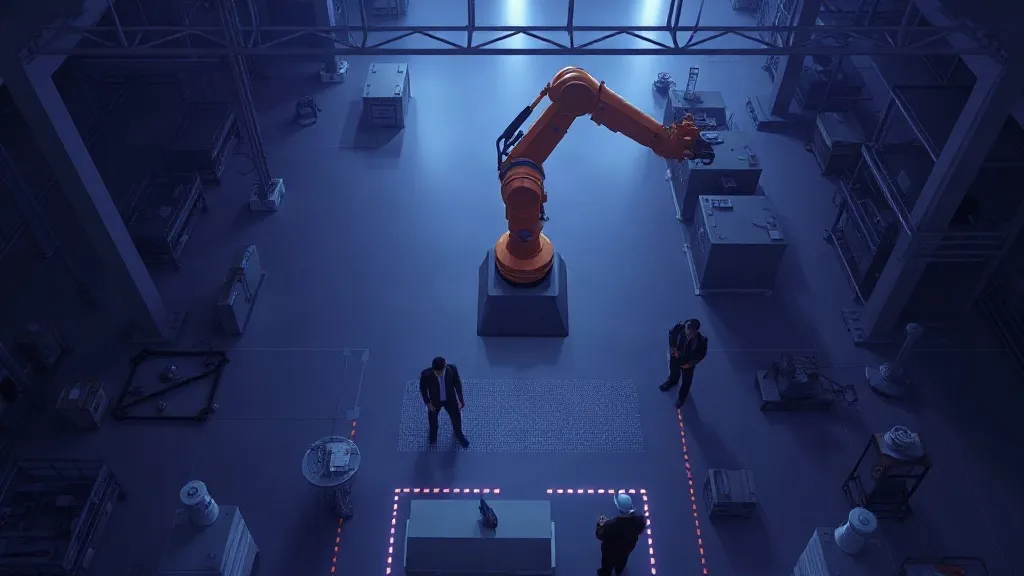
Workplace safety has become a top priority as industrial environments grow more automated, connected, and complex, and AI-powered video analytics is the fastest-moving response to that pressure, using computer vision to interpret live feeds and flag unsafe actions as they happen openpr.com. The pitch is straightforward: catch the near miss before it becomes an incident report. The governance question underneath it is less straightforward, and manufacturers are not yet treating it as the decision it is.
Traditional machine safety relies on discrete, certified components with well-understood failure modes. Safety switches, interlocks, and HMI-based control stations from vendors like IDEM, ABB, and FANUC are built to known standards, tested against known risks smartindustry.com. A switch either closes the circuit or it doesn’t. Video analytics does not work that way. It makes probabilistic judgments about human behavior from a camera feed, and it can miss an unsafe act, flag a false positive, or lose accuracy as lighting, camera angle, or workforce composition shifts. There is no equivalent standard yet for what error rate is acceptable in a camera-based safety layer the way there is for a certified switch.
That gap matters more once the analytics output stops being a dashboard and starts triggering action, a line stop, a supervisor alert, a logged violation against a worker’s record. The EU Machinery Regulation already points toward treating corruption of safety-related software and data as a hazard source under ISO 12100 risk assessment, which means once an AI system’s output feeds a safety decision, it inherits the documentation burden that comes with being safety-related software, not a convenience feature jamasoftware.com. Few manufacturers deploying video analytics today are treating it that way. Most are buying it as an operations tool and discovering its safety implications after the fact.
The sharper problem is evidentiary. A camera that watches for unsafe behavior creates a continuous, searchable record of what the system saw, what it flagged, and what it didn’t. That record cuts in two directions. It can demonstrate due diligence after an incident, showing the hazard was monitored and the response was documented. Or it can become the plaintiff’s primary exhibit, showing the system saw the unsafe act and failed to stop it, or saw it and the organization didn’t act on the alert. Unlike a paper incident report filed after the fact, this record exists whether or not anyone asked for it, and it will be discoverable.
The decision manufacturers need to make now, not after an incident, is whether video analytics output is advisory or control. Advisory output supports human review and training. Control output triggers automated responses and falls under the same rigor as any other safety-related function, including defined behavior for degraded feeds, low-confidence flags, and model drift. Vendors selling the technology are not going to make that classification for a buyer’s shop floor. Physical AI more broadly is moving intelligence into equipment that perceives and reasons within defined boundaries microsoft.com, and those boundaries, for a camera watching workers, have to be drawn by the organization deploying it.
The camera was supposed to make the floor safer to insure. Whether it does depends on a classification decision no one has made yet.
Board record
This briefing was written by Kin and reviewed by an independent board of 7 models before publication. Ruling: CLEARED.
| Seat | Reviewer | Finding |
|---|---|---|
| Chair · Editorial Judgment | Claude | cleared. The core argument—that video analytics creates an evidentiary record that cuts both ways and requires a classification decision manufacturers aren’t making—is coherent and well-supported, though the c |
| Source & Claim Verification | Qwen · local | held. Most factual assertions about video analytics error behavior, regulatory burden, evidentiary discoverability, and manufacturer practice are uncited. |
| Regulatory & Framework Fidelity | Mistral | cleared. The briefing accurately reflects key principles of ISO 42001, EU AI Act, and NIST AI RMF regarding risk assessment and documentation for safety-critical AI systems, but lacks explicit mapping to 21 CF |
| Technical Accuracy | Llama | cleared. The text correctly distinguishes between deterministic safety hardware and probabilistic AI outputs, accurately citing the relevant ISO 12100 risk assessment framework and the distinction between advi |
| Bias, Balance & Hype Control | Gemini | cleared. The briefing effectively identifies and counters potential vendor hype by highlighting the unaddressed governance and evidentiary issues surrounding AI-powered video analytics in workplace safety. |
| Novelty & Non-Duplication | Grok | cleared. The advisory-vs-control classification plus dual-use evidentiary risk framing is a distinct synthesis not reducible to the commodity physical-AI/market/EU-reg wire copy it cites. |
| Validation | DeepSeek | cleared. The briefing’s central claim about the evidentiary risk of AI video analytics is a logical argument about potential legal consequences, not a factual claim that can be validated or refuted against cur |
Sources cited: 20. Validation challenges: 0. Review cost: about $0.04. Learn how these briefings are written and verified.