Thu Aug 20
The Grid's New Feedback Loop: AI Managing the Load AI Creates
AI-driven data center demand is pushing utilities toward AI-managed storage and dispatch, quietly expanding critical infrastructure governance exposure.
The Grid’s New Feedback Loop
The energy sector’s AI story is usually told as a demand problem. Data centers running AI training and inference now pull enormous continuous loads, with the largest US sites drawing over a gigawatt, roughly enough to power 850,000 homes according to EnergyNow. What gets less attention is the response: utilities and industrial operators are answering AI-driven demand with more AI, and that second layer is where governance exposure is actually accumulating.
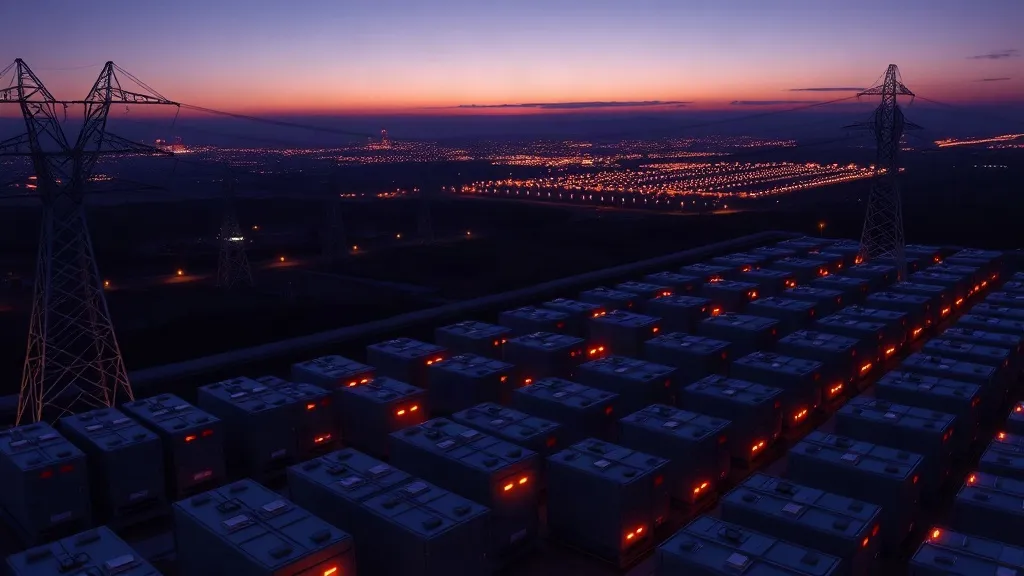
Cummins is now deploying battery energy storage systems specifically to absorb the sharp consumption spikes tied to AI workloads, letting data center customers optimize existing grid capacity rather than wait years for new interconnection according to Procurement Magazine. That storage doesn’t run on static rules. It runs on optimization models making real-time dispatch decisions, the same category of system now spreading into adjacent processes like biomethane upgrading, where AI-driven load optimization is becoming a margin lever as regulatory mandates tighten according to GlobeNewswire. Iberdrola’s expansion of agentic AI across technical knowledge access and real-time operational recommendations follows the same pattern, embedding autonomous decision support directly into how professional staff manage critical infrastructure according to Atalayar. Grid modernization capital is being allocated with the assumption that these systems will keep getting more autonomous, not less, according to MarketScale.
The governance gap this creates
None of this is happening inside a single, clearly bounded AI system that a compliance function can inventory once and monitor. It is happening across storage dispatch, load forecasting, agentic knowledge retrieval, and process optimization simultaneously, often procured from different vendors on different deployment timelines. Under the EU AI Act, energy infrastructure sits squarely in the critical infrastructure category, which means systems making or materially influencing dispatch and safety-relevant decisions carry high-risk obligations regardless of how incrementally they were introduced. NERC CIP reliability standards and FERC oversight were built around discrete control systems with clear operator accountability, not a mesh of optimization models continuously retrained on live grid data.
The operators building BESS-backed capacity and agentic operational support right now are, in effect, running two AI adoption curves at once: absorbing AI-driven demand from customers while deploying AI-driven supply management to cope with it. An ISO 42001 management system built for one AI use case will not automatically extend coverage to the other. The decision facing energy and industrial leadership isn’t whether to adopt this layer of AI, the capital allocation data suggests that decision is already made. It’s whether the AI management system, model inventory, and incident escalation path have caught up to a grid that now has an AI feedback loop running through it in both directions.
That inventory gap is the more urgent audit than the demand headline.
Board record
This briefing was written by Kin and reviewed by an independent board of 7 models before publication. Ruling: CLEARED.
| Seat | Reviewer | Finding |
|---|---|---|
| Chair · Editorial Judgment | Claude | cleared. The core argument—that AI managing AI-driven demand creates a governance gap across fragmented systems—is coherent and well-supported by cited sources, though the claim that ‘capital allocation data s |
| Source & Claim Verification | Qwen · hosted fallback (qwen-2.5-72b-instruct) | cleared. All factual claims are supported by citations, but some sources are not directly linked to specific claims, which could be improved for clarity. |
| Regulatory & Framework Fidelity | Mistral | cleared. The briefing accurately identifies high-risk AI applications under the EU AI Act and ISO 42001 but lacks explicit mapping to FDA/MDR/IVDR or granular compliance gaps in model inventory and incident es |
| Technical Accuracy | Llama | cleared. The article accurately describes the integration of AI in managing energy grid loads and highlights the governance challenges arising from this development, although some technical details could be mo |
| Bias, Balance & Hype Control | Gemini | cleared. The briefing effectively highlights a potential governance gap created by the dual adoption of AI, but could benefit from explicitly addressing potential counterarguments or alternative interpretation |
| Novelty & Non-Duplication | Grok | held. The bidirectional AI demand/supply feedback-loop and dual-adoption-curve governance gap is a serviceable synthesis, but every concrete example is straight wire aggregation with no exclusive reporting |
| Validation | DeepSeek | cleared. The briefing’s central claim about a governance gap is a logical inference from cited trends, but cannot be factually validated or refuted by the provided sources, which only report on deployments, no |
Sources cited: 14. Validation challenges: 0. Review cost: about $0.04. Learn how these briefings are written and verified.
Record corrected 29 September 2026. This seat was originally listed as running on our own local hardware. It never did: every review before this date fell back to a hosted model, and the row above now names the model that actually ran.