Sat Aug 22
When AI Stops Advising and Starts Operating the Grid
As AI shifts from analytics to closed-loop control in energy and industrial systems, validation and human-override design become the real governance test.
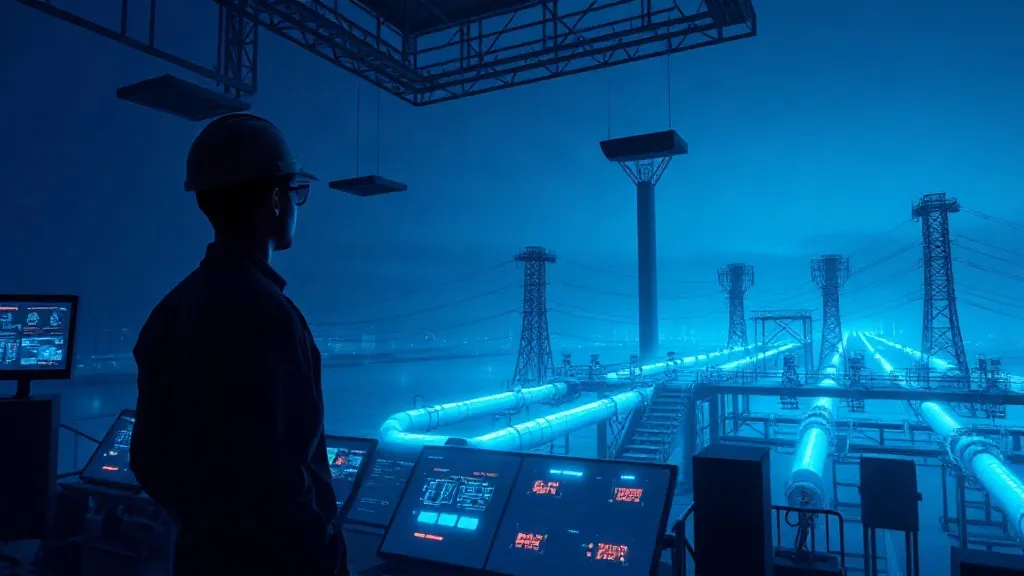
The loop is closing
For most of the last decade, AI in energy and industrial operations sat outside the control loop. It flagged anomalies, forecasted demand, suggested maintenance windows. A human decided what happened next. That division is dissolving. The World Economic Forum describes industrial facilities, commercial buildings and distributed storage assets now running “continuous optimization loops” that blur the line between energy producer and energy user weforum.org. The AI is no longer advising the grid. It is participating in it.
Market data confirms the direction. Hybrid deployment, where local intelligence at the asset level runs alongside cloud-based optimization, is now the fastest-growing pattern in AI-driven energy management, with platforms like Schneider Electric’s One Digital Grid and Stem’s PowerTrack combining both layers precedenceresearch.com. That architecture is efficient. It is also a governance problem, because decisions increasingly execute at the edge, in real time, faster than any human review cycle can keep pace with.
The data gap underneath
This matters more once you look at what industrial AI is actually trained and validated on. A new benchmark effort notes plainly that the main bottleneck for industrial safety intelligence is not model architecture but the lack of high-quality data capable of systematically capturing the complexity and risk patterns of real industrial settings nature.com. If that is true for inspection and safety models, it is doubly true for control-loop models making live dispatch or load-balancing decisions on critical infrastructure. Thin or unrepresentative training data does not just produce a bad recommendation anymore. It produces a bad action.
Skilled trade organizations are already flagging the second-order risk. Automation may improve hazard detection, but overreliance on it can quietly erode the human judgment and organizational resilience needed to manage the unexpected event the model was never trained on ohsonline.com. On the shop floor, the same dynamic is showing up as robots and cobots take on more autonomous function, prompting standards bodies to revisit where the safety boundary between the two categories actually sits mmsonline.com.
What this means for the buyer
For energy and industrial operators, the compliance question is no longer “does the model perform well in testing.” It is whether the organization can demonstrate, under EU AI Act high-risk provisions for critical infrastructure and ISO 42001’s risk management clauses, that closed-loop AI systems carry documented data provenance, defined override authority, and tested failure behavior for conditions outside the training distribution. Procurement teams evaluating grid optimization or plant automation platforms should treat “hybrid deployment” and “autonomous safety monitoring” as triggers for that documentation, not as vendor differentiators to take at face value.
The grid and the factory floor are becoming places where AI acts, not just advises. Governance frameworks built for advisory AI will not hold up once the model is the operator of record.
Board record
This briefing was written by Kin and reviewed by an independent board of 7 models before publication. Ruling: CLEARED.
| Seat | Reviewer | Finding |
|---|---|---|
| Chair · Editorial Judgment | Claude | cleared. The argument is coherent and logically structured—moving from advisory to operational AI, identifying the data quality gap as a risk amplifier, and landing on concrete governance implications—but the |
| Source & Claim Verification | Qwen · hosted fallback (qwen-2.5-72b-instruct) | cleared. All factual claims are supported by citations, but some sources could be more robust or recent for full confidence. |
| Regulatory & Framework Fidelity | Mistral | cleared. The briefing accurately reflects key requirements of ISO 42001 and the EU AI Act for high-risk AI systems in critical infrastructure, but lacks explicit mapping to FDA or MDR/IVDR frameworks, which ar |
| Technical Accuracy | Llama | cleared. The article accurately captures the trend of AI transitioning from advisory to operational roles in energy and industrial operations, but could be strengthened with more technical specifics on AI impl |
| Bias, Balance & Hype Control | Gemini | cleared. The briefing effectively identifies and counters potential vendor hype by reframing ‘differentiators’ as ‘triggers for documentation’ and highlights the critical data gap and human judgment erosion as |
| Novelty & Non-Duplication | Grok | held. Straight synthesis of already-wired WEF, market-report, Nature benchmark, and trade-press items with a familiar advising-to-operating frame; no original reporting or angle that clears non-duplication |
| Validation | DeepSeek | cleared. The central claim that AI is moving from advisory to operational roles in critical infrastructure is strongly supported by cited market trends and governance discussions, though the briefing does not |
Sources cited: 13. Validation challenges: 0. Review cost: about $0.04. Learn how these briefings are written and verified.
Record corrected 29 September 2026. This seat was originally listed as running on our own local hardware. It never did: every review before this date fell back to a hosted model, and the row above now names the model that actually ran.