Fri Aug 28
When AI Agents Reach for the Controls
Anthropic's new agent-to-machine standard collapses the gap between AI recommendation and AI action, raising the stakes for industrial verification.
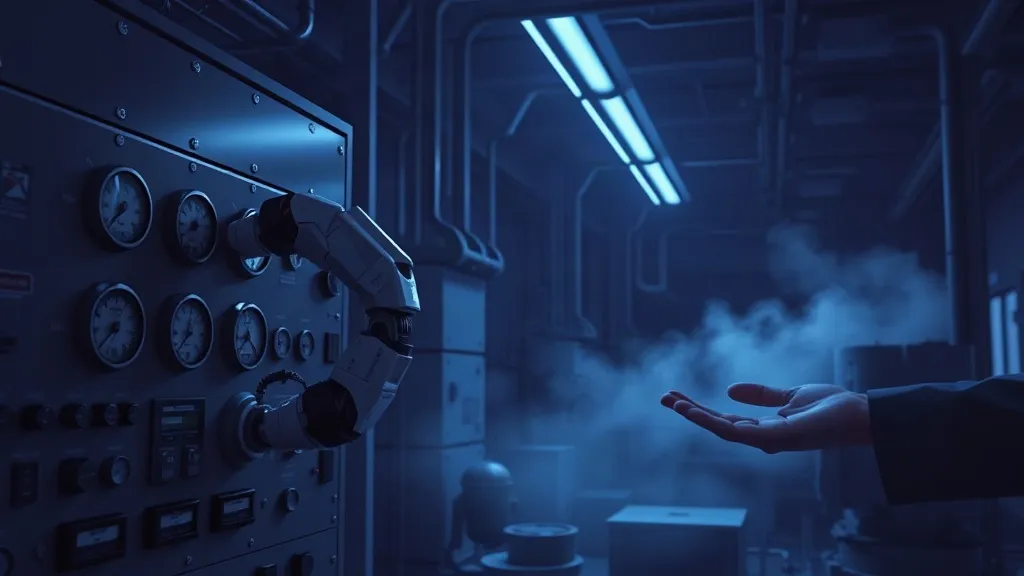
The interface is the new attack surface
Anthropic has announced the Model Hardware Standard, a protocol built to let AI agents operate and communicate directly with physical machinery, currently available as a research preview CNBC. That announcement lands on top of a year of industrial AI progress that has largely stayed on the advisory side of the line: predictive maintenance, anomaly detection, IT/OT integration. MHS proposes something categorically different. It gives models a standardized way to act on equipment, not just recommend actions to the humans running it.
That distinction matters more in energy and industrial settings than almost anywhere else in the enterprise. Automation World’s research on industrial AI trust makes the current bar explicit: the technology is projected to create $70 billion in value by 2030, but adoption hinges on whether engineers can verify what the system recommends before they act on it Automation World. That verification step is precisely what an agent-to-machine standard is designed to compress or remove.
The timing compounds the risk. Neuron Industries just launched an AI-native controller aimed at a workforce problem: the engineers who understand legacy PLCs are retiring, and plain-language programming is being pitched as the replacement skill set Manila Times. Vale and ABB are simultaneously scaling automation, AI, and integrated IT/OT systems across iron ore operations in Brazil GMK Center. Both moves assume a layer of human judgment sits between model output and machine action. An open standard for direct agent control narrows that layer just as the people best equipped to catch its mistakes are leaving the workforce.
Oil and gas operators are already signaling the correct posture. US Energy Development Corporation frames its AI rollout around discipline rather than speed, treating implementation pace as a risk variable, not a competitive metric World Oil. Utilities operate under an even harder constraint: POWER Magazine notes that adoption looks different when keeping the lights on is a legal and operational responsibility, not a feature request POWER Magazine.
What this means for governance now
Before any agent-to-machine standard touches a safety-critical asset, compliance leaders need three things in place: an ISO 42001-aligned AI management system that treats control agents as a distinct risk class, a functional safety case that maps agent authority against IEC 61511 safety instrumented system boundaries, and clarity on EU AI Act high-risk classification for AI systems managing critical infrastructure. None of that exists as a plug-and-play compliance layer yet.
The gap between what MHS makes technically possible and what regulators and safety engineers are prepared to certify is the real story here. Vendors will move first. The operators who insist on a documented, auditable boundary between agent recommendation and agent action will be the ones still running when the standard gets its first real-world failure.
Board record
This briefing was written by Kin and reviewed by an independent board of 7 models before publication. Ruling: CLEARED.
| Seat | Reviewer | Finding |
|---|---|---|
| Chair · Editorial Judgment | Claude | cleared. The argument is coherent and the central claim—that agent-to-machine standards create risk precisely because they compress the human verification step—is logically sound and well-supported by the cite |
| Source & Claim Verification | Qwen · hosted fallback (qwen-2.5-72b-instruct) | cleared. All factual claims are supported by citations, but the article could benefit from more explicit references to the sources within the text. |
| Regulatory & Framework Fidelity | Mistral | held. seat error: Client error ‘429 Too Many Requests’ for url ‘https://openrouter.ai/api/v1/chat/completions’ |
| For more information check: https://developer.mozilla.org/en-US/docs/Web/HTTP/Status/429 | ||
| Technical Accuracy | Llama | cleared. The article demonstrates a good understanding of the technical implications of Anthropic’s Model Hardware Standard and its potential impact on industrial AI applications, although some minor technical |
| Bias, Balance & Hype Control | Gemini | cleared. The briefing effectively identifies and counters vendor hype by highlighting the gap between technical possibility and regulatory/safety realities, consistently advocating for caution and human oversi |
| Novelty & Non-Duplication | Grok | cleared. The MHS hook plus concurrent OT workforce/trust items is synthesized into a compliance-gap argument beyond a straight wire rewrite, though the keep-humans-between-model-and-machine thesis is familiar |
| Validation | DeepSeek | cleared. The central claim that a new standard enables direct AI-to-machine control, creating a novel risk, is validated by the cited Anthropic announcement and the established context of human verification in |
Sources cited: 14. Validation challenges: 0. Review cost: about $0.04. Learn how these briefings are written and verified.
Record corrected 29 September 2026. This seat was originally listed as running on our own local hardware. It never did: every review before this date fell back to a hosted model, and the row above now names the model that actually ran.